GST on Under-Construction Flats 2026 — What You Pay on a ₹1.11 Cr Flat
When you book an under-construction apartment on the Dwarka Expressway, the cost sheet will include a GST line alongside the base price. GST on real estate works differently from GST on goods or most services — the rate depends on the type of property, the price bracket, and whether the project has received its completion certificate. On a flat priced at around ₹1.11 crore — such as an indicative entry unit in a project like Prestige Meadows in Sector 92 — understanding the GST liability helps you plan the total outflow before you commit.
This guide explains the 2026 GST rate for under-construction flats, how the tax is computed, which properties attract a lower or nil rate, and what it adds to the all-in cost of buying. Treat these figures as a well-informed planning estimate and confirm the exact amount with your builder and a CA before signing.
GST on Real Estate: The Basic Rule
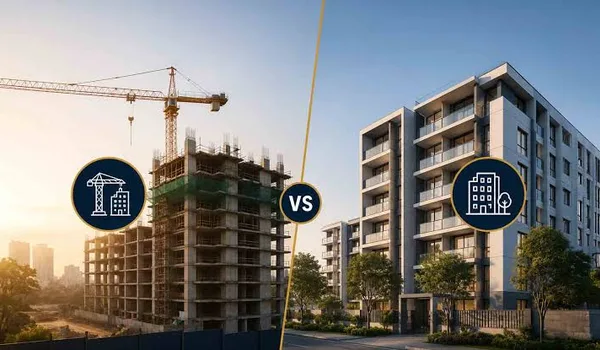
GST on residential real estate applies only when the property is under construction at the time of sale. The moment a developer receives its Completion Certificate (CC) or Occupation Certificate (OC) from the competent authority, subsequent sales are treated as a sale of immovable property — which attracts stamp duty but not GST.
For buyers of under-construction flats, GST is levied on the construction service component of the price. The government treats one-third of the total consideration as the value of the land (which is not subject to GST) and two-thirds as the value of the construction service. The GST rate applies to the construction component only.
GST Rates on Under-Construction Residential Flats in 2026
| Property Type | GST Rate | When It Applies |
|---|---|---|
| Non-affordable under-construction residential | 5% (without ITC) | Flats above ₹45 L stamp duty value — most Dwarka Expressway new launches |
| Affordable housing under-construction | 1% (without ITC) | Carpet area ≤60 sq m in metro & stamp duty value ≤₹45 L |
| Ready-to-move (CC / OC obtained before sale) | Nil / 0% | Builder has its completion or occupation certificate |
Does Your Flat Qualify as Affordable Housing?
The 1% rate is a significant saving, but eligibility is strict. Both of the following must apply simultaneously:
- The carpet area is 60 sq m or less in a metro city (Delhi-NCR, Mumbai, Bangalore, Hyderabad, Chennai, Kolkata) or 90 sq m or less in a non-metro.
- The stamp duty value of the flat is ₹45 lakh or less.
For Dwarka Expressway apartments, including a pre-launch project like Prestige Meadows at an indicative ₹1.11 crore, the stamp duty value is far above ₹45 lakh. These flats fall squarely in the non-affordable category and attract GST at 5% on the construction component. The 1% rate applies to a much cheaper market segment.
How GST Is Calculated on a ₹1.11 Cr Under-Construction Flat
The calculation uses the two-thirds rule: one-third of the total agreement value is treated as the land component (exempt from GST) and two-thirds is treated as the construction service on which GST is charged.
| Item | Amount |
|---|---|
| Agreement value (indicative) | ₹1,11,00,000 |
| Land component — 1/3 of agreement value (not taxable under GST) | ~₹37,00,000 |
| Construction component — 2/3 of agreement value (taxable) | ~₹74,00,000 |
| GST @ 5% on construction component | ~₹3,70,000 |
| Total outflow — agreement value + GST | ~₹1,14,70,000 |
In practical terms, buying an under-construction flat at ₹1.11 crore adds roughly ₹3.70 lakh in GST, taking the pre-registration total to about ₹1.15 crore. On top of that you will pay stamp duty and registration (covered in the stamp duty guide), which adds another ₹6–8 lakh depending on ownership type.
GST on Parking, Club Membership and Maintenance
The all-in cost of a new flat often includes charges beyond the flat itself. Here is how GST typically applies to each.
- Parking space: Usually billed as a separate supply by the developer, often at 18% GST. Confirm with your builder whether parking is included in the agreement value or invoiced separately at a higher rate.
- Club membership or amenity charges: If charged separately from the flat price, typically treated as a service at 18% GST. If bundled into the agreement value, they follow the flat's 5% rate.
- Maintenance during construction (collected by developer): Treated as part of the construction service, so generally included at 5%.
- Monthly maintenance after possession (to the RWA): Exempt from GST if the per-unit monthly contribution is ₹7,500 or less. If it exceeds ₹7,500 per month, GST at 18% applies on the full amount. Confirm the expected maintenance figure with the developer at booking.
When Does GST Not Apply?
Two scenarios attract zero GST on residential flats:
- Ready-to-move flat with CC/OC: If the project has its Completion Certificate or Occupation Certificate before the sale deed is executed, the transaction is a sale of immovable property and GST does not apply. This is one of the cost advantages of buying a ready home over an under-construction one.
- Resale flat from an individual seller: A secondary-market transaction where an individual sells their own flat also does not attract GST. The buyer pays stamp duty and registration charges only.
For a pre-launch project like Prestige Meadows with indicative possession around December 2030, buyers will carry GST through the entire payment schedule. It does not drop away partway through — the project will receive its CC only near the end of construction.
Can You Claim Input Tax Credit?
No. Under the GST framework effective from April 2019, buyers of residential flats cannot claim Input Tax Credit (ITC) on the GST they pay. Builders also cannot pass ITC through to buyers under the current scheme. The 5% rate was deliberately set lower than the earlier effective rate of around 12% precisely because ITC was removed. The GST you pay on an under-construction flat is a sunk cost — it cannot be offset against any future tax liability.
Is GST Included in the Builder's Quoted Price?
This varies by developer. Some builders quote an all-inclusive price (BSP + GST) so the figure you see already incorporates the tax. Others quote BSP exclusive of GST and show GST as a separate line on the cost sheet. Before comparing prices across projects, clarify whether each quote is GST-inclusive or GST-exclusive. A ₹1.11 crore inclusive price and a ₹1.11 crore exclusive price differ by roughly ₹3.5–3.7 lakh on a Dwarka Expressway apartment — a material difference in planning your finances.
Full Upfront Cost Budget Including GST
Pulling the statutory numbers together for a ₹1.11 crore flat in urban Gurugram:
- GST (5% on 2/3 of price): ~₹3.70 lakh
- Stamp duty (urban Gurugram, male buyer at 7%): ~₹7.77 lakh — female buyer (5%) ~₹5.55 lakh
- Registration (capped): ₹50,000
- Down payment (20–25% of price): ~₹22–28 lakh
GST, stamp duty and registration together add roughly ₹9.75–12 lakh to your upfront outflow beyond the down payment. None of these statutory charges are covered by the home loan — they come from your own savings. For the borrowing side, see the home loan & EMI guide. For how tax deductions on the loan can reduce your annual tax bill, see the home loan tax benefits guide.
Tips for Buyers on GST Planning
- Get the cost sheet itemised: Ask for GST, stamp duty, registration, parking and club membership as separate line items. It is easier to plan and to verify.
- Clarify GST-inclusive vs GST-exclusive: Before comparing two builders' prices, confirm whether the quoted figure already includes GST.
- For ready homes, ask for the CC: If a builder claims the flat is GST-free because the project is complete, ask to see the Completion Certificate or Occupation Certificate. No document equals no exemption.
- Check RERA registration: For under-construction projects, verify the project on Haryana RERA. The registered cost schedule is a useful cross-check on what you should be charged.
- Do not include GST in your home loan application: Banks do not finance GST, stamp duty or registration. These must come from savings.
Frequently Asked Questions
1. Is there GST on an under-construction flat in 2026?
Yes. Under-construction residential flats attract GST. The rate is 5% for non-affordable housing, which covers most Dwarka Expressway apartments priced above ₹45 lakh in stamp duty value, and 1% for affordable housing. GST applies on the construction component of the price, taken as two-thirds of the total agreement value under the current rules.
2. What GST applies to a ₹1.11 crore flat in Gurugram?
A flat at roughly ₹1.11 crore does not qualify as affordable housing under GST, so the 5% rate applies on the construction component. That component is two-thirds of the agreement value, or about ₹74 lakh, giving a GST liability of around ₹3.70 lakh. The total all-in cost with GST is roughly ₹1.15 crore before stamp duty and registration. Confirm the exact figure with your builder.
3. Is there GST on a ready-to-move flat?
No. A flat that has received its Completion Certificate or Occupation Certificate before the sale is treated as a sale of immovable property, not a construction service, so no GST applies. This is one of the cost advantages of buying a ready-to-move flat. The trade-off is usually a higher sticker price.
4. What is the affordable housing GST rate in 2026?
Affordable housing attracts GST at 1% instead of 5%. To qualify, the carpet area must be 60 sq m or less in metro cities including Delhi NCR, and the stamp duty value must not exceed ₹45 lakh. A flat at ₹1.11 crore has a stamp duty value far above ₹45 lakh and does not qualify for the affordable rate.
5. Is GST charged on parking and club membership separately?
Usually yes. Parking and club membership are typically billed as separate supplies by the developer, often at 18% GST. Maintenance charges paid to a residents welfare association after possession are exempt from GST up to ₹7,500 per unit per month. Confirm the breakdown with your builder at the time of booking.
6. Can I claim Input Tax Credit on the GST I pay on my flat?
No. Under the GST framework for residential real estate effective from April 2019, buyers cannot claim Input Tax Credit on the GST paid on their flat. Builders also cannot pass ITC through to buyers under the current scheme. The 5% rate was set lower precisely because ITC was removed. The GST you pay is a sunk cost and cannot be offset against any future tax liability.
Conclusion
For an under-construction flat at an indicative ₹1.11 crore on the Dwarka Expressway, GST adds roughly ₹3.70 lakh to your upfront cost — 5% on the two-thirds construction component of the agreement value. Combined with stamp duty (₹5.55–7.77 lakh by ownership type) and registration (₹0.50 lakh), the statutory charges above your down payment come to approximately ₹9.75–12 lakh. None of this is covered by the home loan, so it must come from savings. Ask your builder to itemise every charge on the cost sheet, confirm the CC status if GST exemption is claimed, and review the home loan tax benefits guide to see how income-tax deductions can partially offset the annual EMI cost.
Ready to look at the flat? Start with the current price list, review the floor plans, or book a site visit. For more buyer guides, visit the Prestige Meadows blog.
More from the Blog